
The Friction That Was Doing Work
On Archival Friction as a Formal Concept

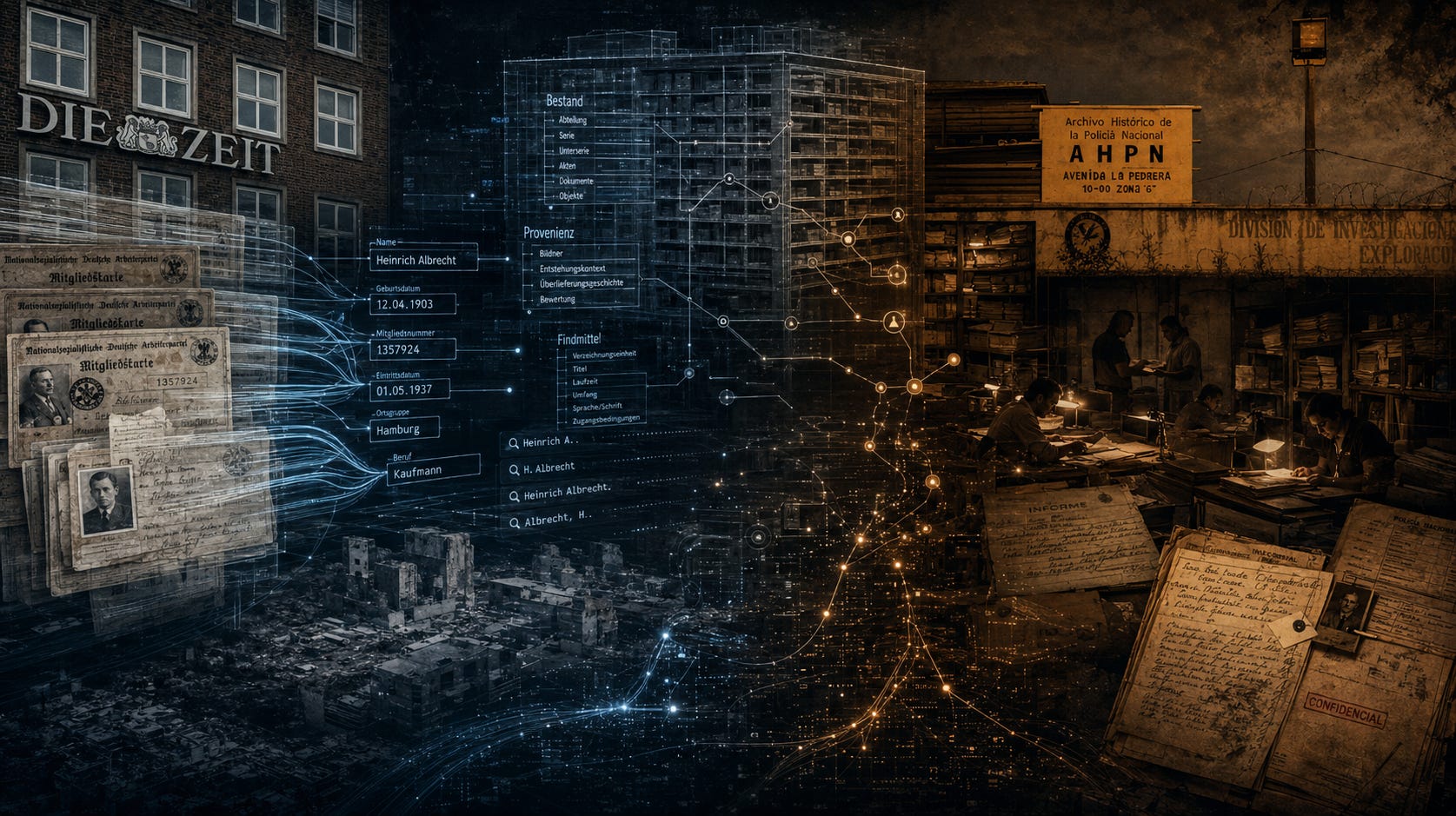
The Friction That Was Doing Work
On Archival Friction as a Formal Concept
Andrew Potter · MetaArchivist
Earlier this week, I wrote about what I called the NSDAP information event: the quiet release by NARA of millions of digitized Nazi Party membership cards, the AI-assisted search interface built on top of them by Die Zeit, and what that sequence revealed about the collapse of archival governance in a world of mass digitization. That piece, Provenance Without Context, was primarily diagnostic. It mapped what happened and what existing frameworks, particularly the University of Virginia Archival AI Protocol, could and could not say about it.
This piece is about something I named but did not fully develop there: the concept of archival friction, and what it might mean to take it seriously as a formal theoretical category rather than a descriptive metaphor.
Let me start with a recap for readers who haven’t encountered the NSDAP case. Then I want to make a harder argument.
What Happened, Briefly
Sometime in early 2026, NARA completed digitization of Microfilm Publication A3340, the biographical NSDAP membership series, and made it findable through its online catalog. Estimates of the number of card images now accessible vary considerably; figures cited in German-language reporting have ranged upward from ten million, with some accounts suggesting more than sixteen million, though NARA has not published a precise count. All of them became accessible to anyone with a browser. There was no press release. No announcement. NARA’s own FAQ page still directed researchers to the microfilm reading room at College Park.
The catalog changed. The institutional communication layer did not.
Researchers and genealogists noticed independently. German-language forums circulated navigation guides. Then Die Zeit built an AI-powered search interface over the material and launched it in April 2026. People began typing family names. What had been an institution mediated by professional gatekeeping became a networked public event, with access shifting from controlled archival research to mass simultaneous interaction by users with no archival preparation.
What Die Zeit’s AI extracted were structured fields, name, birth date, birthplace, occupation, party membership number, entry date, local party group, from card images written in Kurrent and Sutterlin, the blackletter scripts of 1930s Germany. It built a searchable database. What the public interface does not disclose and does not appear in search results includes handwritten marginal notations, corrections, status updates, cross-reference numbers linking to companion files, evidence of coercion or circumstances, duplicate cards, and clerical errors. The contextual tissue of the record remains in the image, invisible to the extraction layer as users experience it.
The result was, in effect, a finding aid with no archivist: structured data floating free of interpretive accountability, linked back to card images through an undisclosed AI pipeline, presented to users with no way to see the layers between what they searched for and what they found.
Three distinct objects now exist: the original cards in the Bundesarchiv; NARA’s digitized images; and Die Zeit’s AI-extracted structured database. Each has a different provenance, reliability, and accountability structure. Most users experience only the third, and the layers between them are not visible in the search interface.
This is the situation that put the concept of archival friction in front of me.
Friction as a Term of Art
The phrase is not new to the humanities. Anna Tsing’s Friction: An Ethnography of Global Connection (2004) theorized friction as productive resistance in global systems, the traction that makes things happen, as well as the heat generated in the process. Friction is not simply an obstacle. It is also what connects.
In archival studies, friction has appeared in scattered and largely unsystematic ways. A 2024 paper in Archival Science examined points of friction in Indigenous knowledge infrastructures, introducing what the authors called the concept of systemic friction, meaning places where the historical trajectories of colonialism conflict with efforts to center Indigenous knowledge. The postcolonial and critical archival literature has long cataloged what Saidiya Hartman has called archival violence, the obliteration of lives through absences and silences, and what others have extended to include archival abjection, archival silence, and the violence of the finding aid. These are accounts of friction in the destructive register: the resistance imposed by power on those it wished to make invisible.
What has been missing is a complementary account, an analysis of archival friction in the productive register. Not friction as a barrier, but friction as a mechanism, the resistance that does necessary epistemic and ethical work, and whose removal has consequences that require theoretical accounting.
That is the concept I want to develop here.
What Friction Was Actually Doing
Before the NSDAP materials became findable through a browser, accessing them required physical presence or institutional intermediation. A researcher traveled to College Park. Requested microfilm. Navigated a finding aid that described collections at the series and roll level. Manually browsed within rolls, since individual cards carried no item-level descriptive metadata. Worked through the handwriting, the Gothic script, the microfilm degradation, and the absence of context. And did so, frequently, with a reference archivist somewhere in the building who might be consulted, might offer orientation, might ask what the research was for.
This process was slow. It was also generative of something we have not yet named precisely: a compulsory encounter with the record as a record.
By the time a researcher arrived at a specific card, they had typically absorbed, through the friction of getting there, a working understanding of what kind of object they were looking at. They knew it was a membership card, not a confession. They knew the collection had known destruction rates. They understood the difference between the Zentralkartei and the Ortsgruppenkartei and what each could and could not tell them. They had learned, through the process of access, that a found name was the beginning of a question, not the end of one.
This was not universal. Researchers historically misread provenance, ignored contextual cues, and bypassed archivists entirely. But friction frequently carried context. It often functioned as contextualization. And crucially, it created conditions in which contextualization was likely to occur even when it was not sought.
Friction as forced contextualization
This suggests the first formal property of productive archival friction: friction as forced contextualization. The resistance built into a discovery process shapes what the discoverer knows about the thing they have discovered by the time they reach it. When friction is removed, that knowledge has to come from somewhere else, or it does not come at all.
The second property follows. Friction generates a self-selecting user population. The people who actually worked with the NSDAP files before digitization were few and predominantly expert, not because the records should have been restricted, but because the barriers filtered toward preparation. This is uncomfortable to say plainly, because it sounds like a defense of exclusion. It is not. It is an observation about the relationship between access conditions and interpretive capacity. The question the NSDAP event poses is not whether more people should be able to search the records, and the answer to that is clearly yes, but whether the removal of all access friction simultaneously and without replacement leaves interpretive capacity somewhere in the system. The evidence suggests it does not.
Friction as interpretive sorting
Call this the second property: friction as interpretive sorting. Not a permanent or desirable sorting by credentials or class, but a temporary sorting by preparation. The governance challenge is to achieve sorting without exclusion, to ensure that when someone arrives at a record, they have encountered the context that makes the record intelligible, regardless of the path they took to get there.
The third property is more subtle. Friction introduces time. And time, in high-stakes information environments, creates space for second thoughts. The reference archivist who hands you a file is a moment of human judgment in the chain, someone who may say something, ask something, notice something, slow something down. The process of requesting microfilm is a pause in which the requester might reconsider the purpose of the request or encounter a colleague who offers a different perspective. The process of manual browsing within a roll is a time when the researcher is absorbing, reconsidering, and reorienting.
Friction as a temporal buffer
Call this the third property: friction as a temporal buffer. Speed is not neutral. In archival contexts where records carry significant potential for harm, to living people, to their descendants, to the historical record itself, speed amplifies error and forecloses the reconsideration that slower processes permit. Frictionless access compresses this buffer to near zero.
Friction as provenance architecture
The fourth property is architectural. The layers of friction in the old system, reading room, microfilm, roll navigation, and manual card browsing roughly corresponded to the layers of the archival record itself. Each level of access friction is mapped onto a level of archival structure: collection, series, file unit, item. When you worked through each layer, you encountered the record’s context in roughly the order in which that context was constituted. The friction was, in a sense, the architecture of provenance made physical.
When friction is stripped away and replaced by a search interface, the architectural correspondence collapses. The user arrives at the item level, the extracted name, the matched card, without having passed through the collection level, the series level, or the file unit level. Provenance, which classical archival theory treats as the foundation of the record’s meaning, is no longer traversed. It is bypassed.
Call this the fourth property: friction as provenance architecture. The resistance built into access is not accidental to the record’s context. In the physical and institutional archive, it is a structural encoding of that context. Its removal is not a neutral simplification. It is a reorganization of what the record means.
There is a deeper claim underneath all four properties that deserves to be named explicitly. Archives, as they historically functioned, were epistemic infrastructures. They embedded interpretive sequencing into physical and institutional access structures. The archivist, the reading room, the finding aid, the microfilm reel, the folder, and the document were not simply delivery mechanisms. They were an ordered encounter with context that shaped what the record meant by the time it was read. What AI retrieval systems optimize for is something categorically different: answer delivery, independent of interpretive sequence. That shift, from epistemic infrastructure to retrieval infrastructure, is what the concept of archival friction is ultimately trying to name.
The Inversion: Guatemala
Before this argument hardens into a defense of the reading room, I want to hold it against a case that cuts in the opposite direction. Because the concept of archival friction will be worthless as a theoretical tool if it cannot account for situations in which friction itself was the crime.
In July 2005, investigators from Guatemala’s human rights ombudsman’s office stumbled into an abandoned warehouse on the grounds of a working police base in downtown Guatemala City. What they found was approximately eighty million pages of records belonging to the former National Police, an institution that had served as one of the primary instruments of state terror during the country’s thirty-six-year civil war. The records detailed surveillance, arrests, disappearances, and killings. They were rotting with mold. They had been left to disintegrate in five crumbling buildings without an inventory or a finding aid.
This was not an accidental preservation failure. The Guatemalan military and police had refused to participate in the truth commission that preceded the 1996 peace accords and denied investigators access to government archives. The archive’s physical deterioration was the continuation of suppression by other means. Friction, in the form of physical inaccessibility, institutional denial, and deliberate deterioration, was the instrument of ongoing impunity.
The political valence here is specific and should be named rather than obscured: the harmful archival friction in Guatemala was generated by right-wing military and political institutions resisting accountability for documented atrocities. That historical fact is not in dispute. But the theoretical argument does not depend on it. Archival suppression has been practiced across the political spectrum, by left-wing states and right-wing ones, by colonial administrations and postcolonial governments, by democracies protecting intelligence sources and authoritarian regimes protecting perpetrators. The structure of the problem, power using friction to evade the historical record, does not belong to any single ideological tradition. The Guatemala case is illustrative, not representative of a political alignment.
The Archivo Historico de la Policia Nacional, which emerged from that warehouse under the leadership of Gustavo Meoño Brenner, spent years cleaning, organizing, describing, and digitizing the records. It opened a public reading room in 2009. It granted access to anyone who could visit in person and accepted requests for specific documents from prosecutors, families of the disappeared, scholars, and journalists.
The removal of friction here was itself an act of justice. There is no ambiguity about that.
And yet, and this is the crucial observation, the AHPN did not simply remove all friction. It built a differentiated access model. Walk-in access for general researchers. A mediated request process for specific documents tied to legal proceedings. And, most significantly, an investigations unit: a staff of people who knew the records, understood their limitations, and could connect a found document to its archival context before it went to a family or a prosecutor.
The investigations unit is the key. It is friction in the productive register, deliberately installed after the destructive friction of suppression had been dismantled. It slowed the path from record to conclusion in order to ensure the conclusion was warranted. The unit was a human intermediary layer, staffed by people with genuine expertise in the collection, that performed the interpretive work the physical archive had once performed through its own accumulated difficulty.
This is where the distinction between friction and expertise matters. The AHPN’s investigations unit was not simply a speed bump. It was a concentration of archival knowledge: people who could read what the records said, recognize what they omitted, and translate both for users who lacked that capacity. Friction, as a mechanism, created the conditions for that expertise to operate. But the expertise was the substance. The lesson of the AHPN is that dismantling harmful friction creates a vacancy that only expertise, not just slowness, can fill.
The AHPN, at its best, understood something that the NSDAP digitization did not: that removing harmful friction and installing productive friction are not the same operation, and that doing the first without the second leaves the archive as a loaded instrument in the hands of whoever searches it next.
The Mirror: East Germany
A second comparative case illuminates the problem from a different political direction entirely and demonstrates that the argument here is structural rather than ideological.
In 1990, as German reunification proceeded, citizens and activists seized the headquarters of the Stasi, the Ministry for State Security of the German Democratic Republic, before its officers could complete the destruction of the files. What they rescued was approximately 111 kilometers of shelved records, the surveillance apparatus of a communist state that had employed roughly one full-time officer for every 63 citizens of East Germany, and had recruited an estimated 180,000 unofficial informers from the population it surveilled.
The Stasi Records Act, enacted in December 1991, established the Federal Commissioner for the Stasi Records, known by its German abbreviation BStU, to administer access to the records. What the BStU built was among the most carefully designed tiered access systems in the history of archival governance. Individuals could apply to see their own files. Prosecutors could request records for criminal investigations. Journalists and researchers could access materials with written declarations of purpose and, where records named living third parties, with consent requirements. Vetting of public officials for past collaboration was conducted through a formal review process in which the BStU provided information but explicitly declined to serve as the evaluating authority, leaving the judgment of consequences to the requesting institution.
The system was not perfect. It could be slow. The consent requirements frustrated some research. But the friction it embedded was deliberate and functional: it distinguished between uses of the same records by their purpose and consequence, and it placed human judgment at the point where a record could cause harm to a living person.
What happened when records escaped that system without their contextual tissue illustrates the stakes precisely.
In December 1990, Der Spiegel published a report stating that a Stasi card had been found linking the code name “Czerny” to the address of Lothar de Maiziere, East Germany’s first and last freely elected prime minister, who by then was a minister in Helmut Kohl’s unified German government. The card alone was treated as sufficient evidence. De Maiziere resigned within days. Former Stasi officers told magazines he had worked as an informer for eight years. His denials were disbelieved. His main file was missing.
Decades later, the question of his actual guilt remains contested. The Washington Post noted in 2000 that nothing had emerged to indicate that “Czerny” was not de Maiziere, but also that the case rested entirely on circumstantial evidence from documents whose reliability Vaclav Havel, among others, had publicly challenged. A Stasi card linking a code name to an address is not a confession, a corroborated report, or a moral verdict. It is a bureaucratic entry in a surveillance system designed to cast suspicion as widely as possible.
The de Maiziere case is, in microcosm, the NSDAP problem: a single card, extracted from its archival context, treated as dispositive evidence of a character conclusion the record cannot actually support. The difference is that in 1990, decontextualization occurred through journalism rather than AI, and the friction that might have slowed it stemmed from a system still being built rather than one deliberately dismantled.
The BStU’s response to the de Maiziere episode and others like it was to tighten the interpretive layer around record disclosure, not by restricting access to the records themselves, but by insisting that the agency’s role was to provide documents, not to render verdicts. That distinction, between transmitting a record and adjudicating its meaning, is precisely what the doctrine of designed friction is trying to preserve. The BStU understood, through painful early experience, that records of surveillance and persecution are instruments that can be turned against their subjects’ victims as easily as against their perpetrators, and that the governance framework around them had to account for both.
The political origin of the harmful friction in East Germany was left-wing, a communist state’s apparatus of population control. The governance framework that the reunified German state built to dismantle it was designed by center-right and center-left governments working under a cross-party consensus. The productive friction the BStU installed drew no ideological line. Its purpose was epistemic: to ensure that records generated by a system designed to produce politically convenient conclusions about people would not, in their afterlife, continue to do so.
That is not a left- or right-position. It is an archival one.
The Concept Formalized
Archival friction, then, is not a single thing. It is a family of related mechanisms, some harmful and some productive, distinguished not by their structure but by their function and direction of effect.
Harmful archival friction is resistance that serves the interests of power rather than those of access, accountability, and memory. The Guatemalan state’s weaponization of archival inaccessibility is one clear case. The East German state’s generation of a surveillance archive designed to produce false or coerced records is another, at the opposite end of the ideological spectrum. But harmful friction also includes the ambient friction of institutional inertia, reading rooms that exclude by class and credential rather than by design, finding aids written for specialists, travel requirements that effectively reserve archives for the tenured. This friction deserves the critique it has received from critical archival theory. It is real and consequential, and it has done significant damage to the historical record by making certain communities and their histories effectively inaccessible.
Productive archival friction is resistance that serves the epistemic and ethical requirements of responsible access, ensuring that records reach users with enough context to be understood for what they actually are. It operates through forced contextualization, interpretive sorting, temporal buffering, and provenance architecture. It is what the reference archivist did, informally, for generations. It is what the AHPN’s investigations unit did explicitly and deliberately. It is what the BStU’s tiered access framework encoded in statute. It is what neither the NSDAP digitization nor Die Zeit’s extraction layer did.
The theoretical contribution of this distinction is as follows. The critical archival literature has spent two decades developing powerful tools for identifying and contesting harmful archival friction. What it has not yet developed is an equally rigorous account of what productive friction was doing, and what needs to replace it when it is removed. That gap is not merely academic. As AI tools for document processing become commoditized and mass digitization accelerates, the productive friction built into archival systems over centuries is being stripped out at scale, without replacement, without announcement, and often without anyone in the institution realizing what is being lost.
The problem is not that NARA digitized the NSDAP files. The problem is that digitization, in the current paradigm, is understood as a purely beneficial process: more access, more equity, more openness. When it is, in fact, a transformation with winners and losers. What is gained is reach. What is lost, unless deliberately replaced, is the friction that reach used to carry.
Toward a Doctrine of Designed Friction
If archival friction is a real concept with real theoretical content, it implies a practical corollary: the profession needs a doctrine of designed friction. Not a defense of old barriers. Not a nostalgia for the reading room. A principled account of what productive friction was doing at each stage of archival access, and what mechanisms, human, institutional, or designed into interfaces and metadata, can perform that work at a digital scale.
Four mechanisms suggest themselves, corresponding to the four properties identified above.
Contextualization by design. If friction forced contextualization, the question is how to deliver context to users who arrive at records through frictionless paths. This is partly an interface design problem: a search result that returns a card image without any interpretive layer is categorically different from one that returns a card image embedded in a structured account of what the collection is, what it cannot tell you, and what the scholarship says about how to read it. But it is also a metadata problem: context needs to be machine-readable, attached at the item level, and surfaceable wherever the record travels, including into AI-extracted derivatives that may propagate far beyond the original catalog environment. The Die Zeit interface could, in principle, surface a mandatory contextual header before every search result explaining that NSDAP membership was a bureaucratic status with widely varying individual meaning, that known destruction rates affect what any absence of a record can tell you, and that the data users are searching is a derivative of a derivative, not the archival record itself. That is not a technical impossibility. It is a governance choice that was not made.
Tiered access by purpose. If friction performed interpretive sorting, the question is how to approximate that sorting without the old exclusions. The BStU framework is the most fully developed existing model: immediate personal access for individuals seeking their own files, formal request and purpose-disclosure requirements for researchers and journalists, a separate institutional process for vetting of public officials, and an explicit refusal to serve as the evaluating authority for conclusions that should be drawn by others. Tiered access models of this kind, calibrated to the consequences of different uses rather than the identities of different users, are the most promising available mechanism for archives of records carrying significant potential for harm.
Mandatory provenance trails in derivatives. If friction encoded provenance architecture, the question is how to ensure it survives transformation. The Die Zeit database is the central failure case: it is a proprietary, AI-processed derivative that sits between millions of users and the archival record, with no visible account of its methodology, error profile, or limitations. A governance doctrine of designed friction would require that any AI-processed derivative of archival materials carry a mandatory provenance disclosure, not buried in terms of service, but surfaced at the point of use, describing what transformations were applied, what was lost, and what the derivative cannot tell you that the original could. The de Maiziere case is a reminder of how long the consequences of a decontextualized record can persist: a card linked a code name to an address in 1990, and the question it raised remained unresolved thirty years later.
Institutional responsibility downstream. If the archive’s responsibility once extended through the reading room interaction, through the reference archivist’s judgment, through the access request process, then in a digitized environment, that responsibility needs to extend into the downstream environment that disclosure creates. The formulation from Provenance Without Context deserves to be stated as a principle: archival stewardship cannot end at the moment of access. When a catalog update is functionally equivalent to publishing a document of mass social consequence, the archive’s responsibility for contextual governance extends into whatever happens next.
None of these mechanisms recreates the reading room. None of them requires that access be restricted, slowed, or gatekept in the old ways. What they require is that the work the reading room did, the orientation, the interpretation, the slowing-down, be done somewhere else, by something, before the record reaches a user who has no other way to get it.
The Archivist the System Removed
There is a figure missing from the NSDAP story, and from the story of archival AI more broadly. It is the reference archivist.
Not as a romantic ideal. Not as a gatekeeper to be defended. But as the human being who, for generations, performed the work of productive friction: who knew the collection, who could read the handwriting, who understood what the record could not tell you, who asked what you were looking for and why, who occasionally said “you should also look at this” or “be careful about that.”
The reference archivist is being removed from the system at scale, as digitization eliminates the need for physical presence and AI extraction eliminates the need for manual description. The removal is treated as progress, and in some dimensions, it is. More people can access more records. That matters.
But the archivist was not only a gatekeeper. They were also an interpretive layer, a contextual relay, a friction mechanism through which archival expertise reached users who did not possess it themselves. When they are removed without replacement, when the gate opens but nobody stands near it anymore, what disappears is not just a job. It is a function. And functions that disappear without replacement do not simply cease to be performed. They stop being held accountable.
What the NSDAP event made visible, and what Guatemala and East Germany clarify by contrast, is that the question of archival friction is ultimately about where interpretive responsibility lives within a system. In the physical archive, it lived partly in the structure of the institution and partly in the judgment of the people who inhabited it. In the digital archive, it needs to live somewhere else: in metadata, in interface design, in tiered governance, in mandatory provenance trails, in institutional commitments that extend downstream.
The doctrine of designed friction is, in the end, a doctrine about what archival institutions owe to the records in their care, to the people those records describe, and to the users who will encounter both and who deserve to know what they are actually looking at.
That is not a technical problem. It is a professional one. And the profession has not yet fully faced it.
Andrew Potter writes about archives, records governance, AI, and the infrastructures of institutional memory. His previous piece, Provenance Without Context, examined the release of NSDAP membership files and the limits of existing archival AI governance frameworks.
This article on friction as a formal concept is critically important. First, thank you for your work and thought; I believe in what you are doing.
My insight about the connection between your work and mine is that AI has reduced very specific problematic frictions in my life in two directions at once. For decades, those frictions both isolated my understandings and inner world from clear written expression and engagement with other humans working on the important issues of our day, and kept me from discovering and digesting their intellectual work. AI has become a kind of cognitive prosthetic: it enables and supports me to investigate and intellectually digest the world as it overlaps my own understandings, and to express those ideas in a cogent form where I had been thwarted by the costs and overload of everyday life.
Because of that, I’m deeply hopeful that your formal concept of Friction is adopted widely. At the same time, I’m concerned that humanity is now running headlong choosing in one instance after another to add the grease of AI to our braking systems. I feel an added urgency because current AI systems have no truly reliable way to distinguish authorship at the most basic level—human or Ai. The pollution of our human content with machine‑made records is not a minor danger when those records feed into archives, institutions, and civic memory.
As an artist, my 40 years of active work have revolved around a central theme: that reciprocity is required for balance, equity, and global survival. Your articulation of friction as something that can and should do ethical work in our systems resonates deeply with that theme. I’m glad to have found your work.