
Provenance Without Context
What the NSDAP Membership Files Reveal About AI, Archives, and the New Information Order

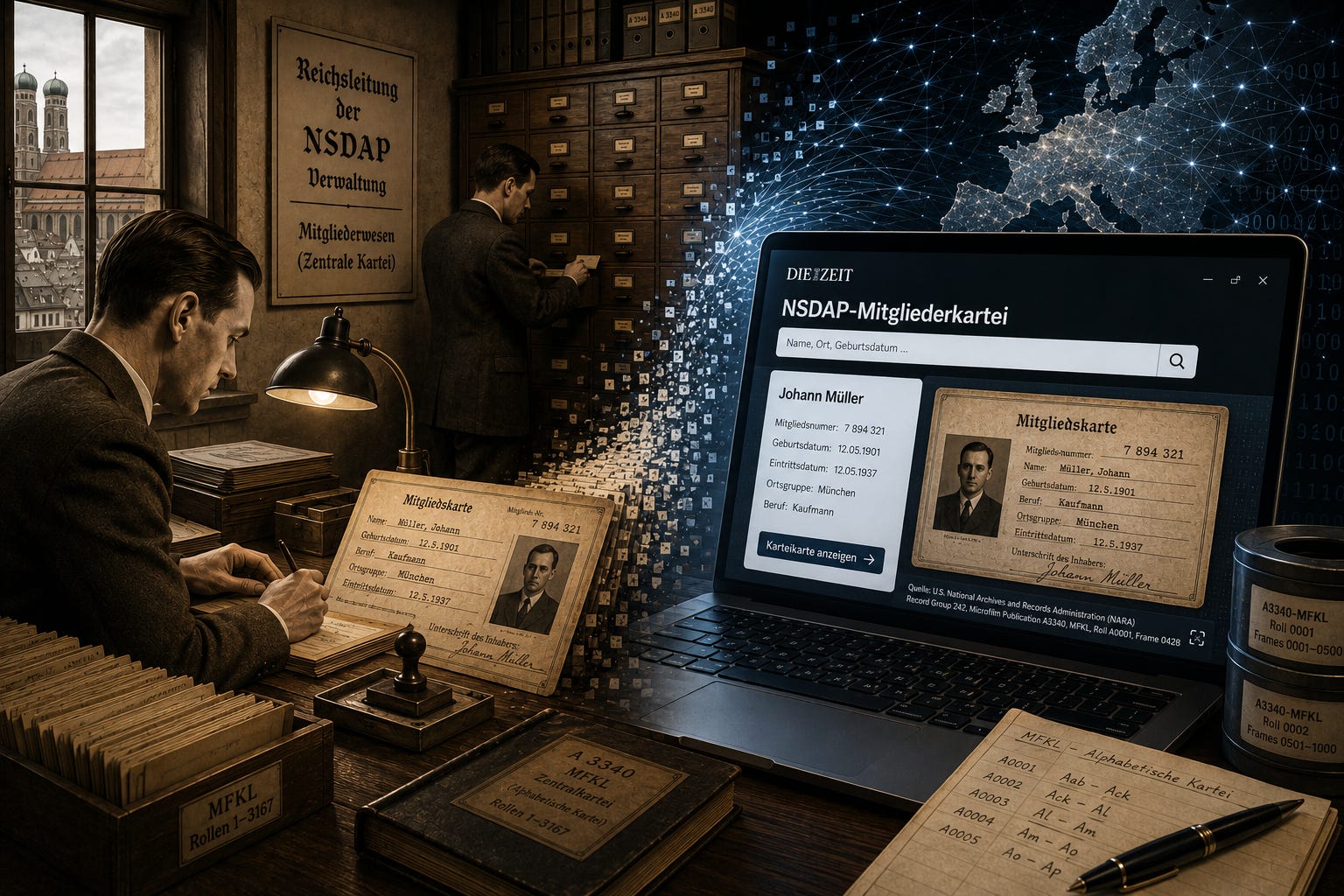
In early 2026, the United States National Archives and Records Administration (NARA) made something extraordinary available from a browser window: millions of digitized images of Nazi Party membership cards — by some accounts more than sixteen million — held within Record Group 242 as Microfilm Publication A3340, freely accessible to anyone with an internet connection.
There was no press release. No newsroom announcement. No featured blog post, public launch event, or media campaign. A review of NARA’s complete press release record for both FY 2025 and FY 2026 confirms this exhaustively. Across those two years, NARA issued public announcements for an Unidentified Anomalous Phenomena (UAP) records release, a new online genealogy series, a JFK assassination records webpage, museum previews, and multiple founding-document exhibitions. It issued a press release in 2009 specifically for a Holocaust-related digital collection launched in partnership with a genealogy platform. The NSDAP digitization — by any measure the largest and most historically consequential record release in either year — appears in none of these communications. More telling still: NARA’s own FAQ page, which describes how to access Berlin Document Center records, appears not to have been updated to reflect the online availability at all — it still directs researchers to the microfilm reading room at College Park.
The catalog changed. The institutional communication layer did not. The records became publicly accessible as NARA records do, when digitization is complete, and access conditions are resolved, through infrastructure, not announcement. Researchers, genealogists, and historians noticed independently. German-language forums began circulating navigation guides. Der Spiegel remarked that “the American archive did not create media hype around the publication, even though the dataset is not only historically important but also extremely extensive.” Multiple other accounts echoed the same observation: the publication had happened quietly, without public framing from the archive itself.
The silence was not routine. It was selective. And that selectivity is itself a data point worth holding.
That absence is not incidental. It is, I want to argue, one of the most important things about this story.
What NARA produced was not a public history initiative. It was an infrastructural archival disclosure. The institution changed the discoverability conditions for a body of records and then, in a sense, stepped back. The wider social and media event that followed — the family reckonings, the journalism, the political reverberations across Germany and Austria — emerged entirely downstream of that catalog update, driven by genealogists, Reddit threads, German historians, and especially Die Zeit’s AI-assisted search interface.
Not long afterward, Die Zeit layered an AI-powered search interface over the material, and the public interest exploded.
People began typing in family names. Neighbors searched neighbors. Local historians searched through town officials. Journalists searched intellectuals, clergy, businessmen, police officials, academics, artists, and grandparents. The archive ceased to be an institution and became an event.
I have been thinking about that transition ever since — and about what it means that we now have, in the University of Virginia Archival AI Protocol, a formal framework designed exactly for moments like this one. The UVA AAIP arrived in January 2026, just weeks before the NSDAP release. It is, in several important respects, a sophisticated and timely document.
But applying it to the NSDAP case reveals something the protocol’s authors may not have anticipated: the framework was designed for institutions deciding whether to open a gate. It has much less to say about what happens after the gate is already open — which is, increasingly, where we live.
What NARA Actually Applied
Before we can evaluate Die Zeit’s AI work, we need to understand what NARA itself put into the catalog — because that metadata architecture is the foundation on which everything else rests.
NARA’s Lifecycle Data Requirements Guide organizes archival description in a strict hierarchy: Record Group → Series → File Unit → Item → Digital Object. For the NSDAP materials, this maps concretely as:
Record Group 242 — National Archives Collection of Foreign Records Seized
Microfilm Publication A3340 — the biographical NSDAP membership series, covering an estimated 10.7 to 12.7 million individuals who joined the party between roughly 1927 and 1945
Sub-series — where meaningful differentiation begins. The two primary membership series are MFKL (Zentralkartei, the central party index: 3,167 rolls) and MFOK (Ortsgruppenkartei, the regional index: 2,275 rolls), alongside specialized series for party correspondence (PK, over 6,180 rolls), Supreme Party Court files (OPG, 1,292 rolls), the 1939 Party Census (PC, 121 rolls), and others
File Unit — individual rolls, identified by codes such as A3340-MFKL-A0001
Digital Object — each scanned image, delivered as pages within a PDF
The critical fact is this: NARA’s metadata sits almost entirely at the series and file-unit level. Individual membership cards received essentially no item-level descriptive metadata. No transcribed names. No birth dates. No membership numbers. No subject access points at the card level. Each scanned image, from NARA’s descriptive perspective, is an undifferentiated frame in a microfilm roll PDF.
NARA’s lifecycle metadata framework permits archival description at the series and file-unit level without item-level metadata for every digital object. Where components of a record have not been individually indexed, agencies may apply series or file-unit-level descriptions to all image files within that grouping. Given the scale, many millions of images, an individual description was never realistic. But the consequence is significant: the catalog entry for any given membership card tells you almost nothing about what is on it. You know it belongs to the MFKL series. You know the roll number. You know the general alphabetical range the roll covers (because researchers have crowdsourced a community index mapping each roll to its name range). Beyond that, you are looking at a scanned photograph of a handwritten card.
There is a thin full-text search layer. The digitization process produced some machine-readable text from the PDFs, allowing keyword searches within rolls — so searching “Müller AND Hamburg” might surface matching frames. But this works at the PDF level, not the card level, and produces results that still require manual browsing within the matching roll. Researchers have observed that approximately every 50th card appears to carry indexed range markers, allowing the catalog to jump to a section; finding a specific card within that section remained a manual task.
This is the metadata environment Die Zeit entered when it decided to build something better.
What Die Zeit’s AI Actually Did
Die Zeit obtained the complete dataset, processed it, and statistically analyzed it — building a searchable database that launched in April 2026. The publication described the tool as built “with the help of AI” but has not released detailed technical documentation of its pipeline. From what has emerged through reporting and third-party analysis, the picture looks roughly like this:
The inputs. The NSDAP Zentralkartei cards follow a standard printed form. Each card contains fields for surname, given name, date of birth, place of birth, occupation, party membership number, date of entry, and local party group (Ortsgruppe). The AI pipeline extracted these structured fields from the card images.
The challenge. The original cards were handwritten or typed in Kurrent and Sütterlin — 1930s German blackletter scripts — then microfilmed, then digitized from microfilm. Standard OCR performs poorly on Gothic handwriting under these conditions. Whatever pipeline Die Zeit used, it appears to have needed to contend with handwriting recognition for Gothic script; normalization of spelling variants and umlauts (a companion index built by third-party researchers notes that “umlauts and common spelling variants are automatically recognized”); disambiguation of extremely common German surnames across millions of records; and error management for degraded microfilm imagery. Die Zeit has not published technical documentation of its methodology, so the precise approach remains undisclosed.
What the publicly searchable layer exposes. The fields the system appears to extract — name, birth date, birthplace, membership number, entry date, occupation, Ortsgruppe — correspond to the structured printed form fields on each card. They are the bureaucratic skeleton of the record, the elements most amenable to pattern recognition across a standardized form.
What the publicly searchable layer does not appear to expose. Handwritten marginal notations. Corrections, amendments, or status updates. Cross-reference numbers linking to companion files. Evidence of coercion or circumstance. Duplicate cards, clerical errors, anomalous entries. The contextual tissue of the record — everything that an archivist reading the card would notice and flag — does not appear to surface in the searchable database. It remains in the image, invisible to the extraction layer.
The derivative status of the Die Zeit database. This is the point most commentary has missed. The searchable database that millions of people are now using is not NARA’s archival data. It is a proprietary AI-processed derivative — a new object, built from the records, carrying its own error profile, its own undisclosed methodology, and its own institutional provenance (a German newspaper, not an archive). There are, in this sense, at least three distinct objects in play: the original cards in the Bundesarchiv; NARA’s digitized images in the catalog; and Die Zeit’s AI-extracted structured database. Each has a different provenance, reliability, and accountability structure. Most users experience only the third layer, and the layers between them are not visible in the search interface.
The UVA Protocol: Three Pillars, Three Problems
The University of Virginia Archival AI Protocol, released in January 2026, establishes a governance framework built around a core rule: irreversible AI models do not get access to archival materials unless item-level provenance and meaningful attribution can be demonstrated in practice, and the archival organization retains contractually enforceable control to stop further use.
The protocol organizes evaluation around three foundational pillars. Running the NSDAP/Die Zeit case through each one is instructive — less because it produces a clean verdict than because it maps exactly where archival AI governance currently has purchase and where it does not.
Pillar One: Provenance and Attribution
The protocol’s first threshold is stated plainly: if the AI cannot cite its source, it cannot use the archival material. Where provenance and attribution cannot be maintained to the organization’s standard, archival material will not be used for AI training or for public-facing AI services.
Applied to the NSDAP case, this pillar cuts in two directions simultaneously.
Where provenance is held. The chain of custody for these records is unusually well-documented. Munich party headquarters → U.S. Army seizure, 1945 → Berlin Document Center → German Federal Archives, 1994 (originals) → NARA’s Record Group 242 (microfilm copies) → digitization, 2025. NARA’s series-level metadata preserves this provenance at the collection level. Die Zeit’s tool does link search results back to individual card images in the NARA catalog. In that narrow sense, source attribution survives.
Where provenance broke down. The protocol calls for item-level provenance. NARA applied almost no item-level descriptive metadata to individual cards. Die Zeit’s AI pipeline then generated new structured data from those images, but that derivative layer carries little documented provenance of its own. There is no published methodology explaining which fields were human-verified and which were AI-inferred, what error rates existed for Gothic handwriting recognition, how duplicate or anomalous cards were handled, or how the system addressed the approximately 20 percent of original party membership records that did not survive. When users search the database and receive a hit, they encounter AI-extracted data of uncertain reliability linked back to an archival image through a largely opaque extraction process. Provenance survives at the image level. It becomes much less clear at the level users actually experience.
The Die Zeit database is, in the protocol’s terms, a public-facing AI service built on archival materials. Under a strict reading of Pillar One, the project raises significant concerns regarding provenance and attribution. Yet Die Zeit had no obligation to comply with the UVA AAIP. The protocol is nonbinding, and it was not written with this use case in mind. The gap here is not one of bad faith. It is one form of absent governance. The framework assumes an archive negotiating access to controlled collections. The NSDAP case instead involved openly accessible digitized records transformed downstream into an AI-mediated public discovery system outside archival control.
Pillar Two: Donor, Community, and Ethical Obligations
The protocol’s second pillar requires honoring all commitments made in deeds of gift, transfer documentation, and purchase agreements — protecting donor communities from having their materials repurposed for AI use without consent.
The NSDAP case scrambles this framework in ways the protocol’s authors could not fully have anticipated.
The records were seized, not donated. NARA’s own guide acknowledges that some materials in Record Group 242 may have been of private origin, and that their seizure is not believed to have divested original owners of any literary property rights. The donor-obligation framework was designed for voluntary transfers. It has no vocabulary for captured enemy state records where the institutional “creator” is the Nazi Party apparatus, and the American government was the captor.
The affected communities are the documented, not the donors. This is the deeper problem. The relevant community interest here does not belong to any institutional transferor. It belongs to the millions of individuals named on the cards — and to their descendants. Those individuals never consented to being indexed in a publicly searchable AI system that answers queries in seconds. The Bundesarchiv maintains access restrictions on the German originals precisely because of remaining personal data protection periods; its guidance notes that a simple full-text search of the database is not possible, with access tied to legal conditions and obligations. NARA, holding microfilm copies rather than originals, and operating under American rather than German data protection law, faced different constraints — and resolved them differently.
The UVA protocol has no explicit provision for what we might call the inverted community scenario: cases where the community with the strongest ethical interest is not the donor community but the subject community. That is a genuine gap in the framework, and the NSDAP case makes it visible in the most consequential possible way.
Pillar Three: Institutional Control
The protocol draws a clear distinction between two types of AI use. General-purpose training — which absorbs data into a model irreversibly — should be presumptively denied. Retrieval-based and controlled internal models — which examine data without absorbing it and keep source materials under institutional control — are generally permitted.
This pillar is where the NSDAP/Die Zeit situation most directly engages the protocol — and where the structural gap is widest.
NARA was not a party to the use of AI. The protocol envisions an archival institution evaluating, negotiating, and contractually governing AI access to its own collections. It requires that the institution assert a “right to stop” before entering into any AI agreement. But NARA performed an infrastructural archival disclosure — it changed the discoverability conditions for a body of records through catalog systems, without public framing, without announcement, without occupying the gatekeeper role the protocol assumes. Die Zeit accessed those public records and ran its own AI pipeline. No contract. No negotiation. No institutional decision point. The gate that the protocol is designed to govern was never invoked, because the archive stepped back from the gatekeeper position entirely. The public event that followed was not NARA’s product. It was NARA’s consequence.
The training/retrieval distinction blurs in practice. Die Zeit’s tool appears to be retrieval-based: the AI extracted structured data from card images, stored it in a database, and search queries run against the database link back to the original images. Under the protocol’s taxonomy, this falls on the “generally permitted” side. But the AI-extracted structured database now functions as a permanent derivative representation of the original records — one with its own error profile, its own selection decisions, and its own proprietary status. The provenance chain from original record to user experience now passes through an undisclosed AI extraction process owned by a media organization. That is a meaningful form of irreversibility, even if it does not technically constitute foundation model training.
This is the structural gap. The UVA AAIP is an excellent framework for institutions deciding how to engage with AI companies that approach them seeking access to controlled collections. It was not designed for — and cannot govern — the scenario where a publicly funded archive digitizes and openly publishes records, and a third party then applies AI to generate a searchable derivative without any institutional negotiation whatsoever. That scenario is not an edge case. It is the dominant pattern for how AI will interact with archival materials over the next decade, as mass digitization continues and AI tools for unstructured document processing become commoditized.
The Finding Aid That Has No Archivist
Step back from the protocol for a moment and consider what has actually been created.
The NSDAP Zentralkartei and Ortsgruppenkartei were designed as administrative control systems — instruments of party management, political surveillance, and organizational accountability. Their evidentiary authority derives precisely from the archival qualities NARA preserved: documented seizure, chain of custody, institutional stewardship, and provenance.
Die Zeit’s database preserves that provenance at the level of the image — each search result links back to a card in the NARA catalog. But the structured data layer the AI generated — the extracted names, dates, birthplaces, membership numbers — is a new object sitting between the user and the record. It is, functionally, a finding aid. But it is a finding aid with no archivist, no methodology statement, no quality-control documentation, no acknowledgment of the gaps created by the 20 percent destruction rate, no interpretive context about what nominal party membership meant under different historical conditions, and no institutional accountability structure.
When an archivist describes a record, that description is a professional act — governed by standards, subject to peer review, embedded in an institutional accountability chain, and ideally accompanied by contextual notes that help users interpret what they are seeing. When an AI extracts structured data from a card image, that extraction is an engineering act — evaluated by precision and recall metrics, not by historical judgment, and typically undocumented at the level of individual decisions.
The distinction matters enormously for the questions the records are now being used to answer. A name in the database is not the same thing as confirmed party membership. It might be a duplicate card. It might be a clerical error. It might reflect membership under coercion. It might be a nominal enrollment with no meaningful participation. The card image, examined by a researcher with archival training, would reveal context. The AI-extracted database entry reveals only the fields the algorithm extracted — and reveals them with a confidence that the underlying material does not always support.
None of this diminishes the enormous historical value of public access to these records. The release has already enabled important historical clarification, family reckoning, and public accountability. For Holocaust research, documentation of perpetrator networks, and the ongoing resistance to historical denial, the mass accessibility of this material represents a genuine advance. For the many families who spent decades wondering about a grandparent’s affiliations, access that once required weeks of formal archive requests now takes seconds. The question is not whether records like these should become accessible. They should. The question is what governance and interpretive obligations accompany accessibility once archival disclosure becomes computational infrastructure at a public scale.
What the Protocol Does Not Yet Say
The UVA AAIP is a significant contribution. Its core insight — that irreversible AI use of archival materials requires item-level provenance, meaningful attribution, and contractually enforceable institutional control — is exactly right. The distinction between training-based and retrieval-based AI use is analytically important. The three pillars provide a coherent evaluative framework for institutions negotiating AI access to controlled collections.
What the NSDAP case reveals is a set of scenarios the protocol does not yet fully address:
The infrastructural disclosure problem. When records are already publicly digitized and accessible — released not through a public-history initiative but through the quiet update of catalog infrastructure — the protocol’s institutional control mechanisms have nothing to grip. This is not a rare edge case. It is the dominant pattern for large-scale archival digitization: the institution changes the discoverability conditions, steps back, and the consequences emerge downstream through forces the archive did not orchestrate and cannot govern. The framework needs a vocabulary for this mode of release — perhaps through mandatory methodology disclosure requirements for any AI derivative built on publicly accessible archival holdings, or through ex-post notification frameworks that activate when AI-processed derivatives of public archival materials reach significant public use.
The inverted community problem. Not all archival materials have donor communities whose interests align with the protocol’s consent framework. For records documenting harm — records created by perpetrators, records of surveillance, records of state violence — the affected community is the documented, not the donor. The protocol needs an ethical framework for this category of materials that centers the interests of the named rather than the transferring institution.
The derivative provenance problem. When AI generates structured data from archival images, that structured data needs its own provenance documentation — not just a link back to the source image, but a published account of the extraction methodology, confidence levels, error handling, and known limitations. Without that, the AI-generated derivative silently substitutes for the archival record in users’ minds, carrying the record’s authority without the record’s interpretive scaffolding.
The contextual governance problem. The protocol focuses appropriately on access and control. But the deeper challenge the NSDAP case poses is not whether Die Zeit should have been allowed to build the tool — it is what interpretive environment should surround the tool’s outputs. Provenance survived the digitization. Context did not always follow. A governance framework adequate for this moment needs to address not just who gets access and on what terms, but also what interpretive architecture must accompany AI-mediated archival retrieval when it operates at public scale.
The Archive as Infrastructure
There is a sentence in the UVA protocol’s framing that stays with me: “Information without origin is a liability.”
The NSDAP case is, among other things, a demonstration of what happens when information retains its origin but loses its interpretive context. The cards have provenance. The provenance is documented. The chain of custody is intact. And yet the experience millions of people are having — typing a name, receiving a result, confronting a family history — strips away almost everything that archivists know about why provenance matters in the first place.
But there is a prior observation, the NSDAP case forces, one that sits upstream of the protocol’s concerns: NARA created a globally consequential informational event simply by changing discoverability conditions. It did not announce the release. It did not frame it. It did not coordinate with German institutions, data protection authorities, affected communities, or media organizations. It updated a catalog. And the rest — the family reckonings, the political reverberations, the AI search tool, the millions of queries, the Austrian journalist discovering his grandfather enrolled five days after the Anschluss — followed downstream, without the archive as author.
This is the emerging normal. Archives are increasingly capable of producing civilizational-scale informational events simply by making records findable. The friction that once mediated discovery — reading rooms, microfilm navigation, formal access requests, reference archivists — is being systematically removed by digitization and AI. What remains on the archival side is a catalog entry. What emerges on the public side is a social event of unpredictable scale and consequence.
The UVA protocol arrived at exactly the right moment to name what is at stake when AI companies approach archives seeking access to controlled collections. Its core framework — item-level provenance, meaningful attribution, contractually enforceable institutional control — is exactly right for that scenario. But it arrived, in the NSDAP case, one gate too late, for a kind of disclosure the protocol was not designed to govern.
The profession’s next challenge is to develop frameworks adequate to the archives we have already opened — not just the ones we are deciding how to open. Mass digitization has been underway for decades. The records are out. The AI tools to process them are here. The derivative databases are being built, whether or not archivists are at the table.
What the NSDAP case makes visible is that archival stewardship can no longer end at the moment of access. When a catalog update can become a public event of this magnitude — when changing a discoverability condition is functionally equivalent to publishing a document of mass social consequence — the archive’s responsibility for contextual governance extends into the downstream environment its disclosure creates.
The NSDAP membership card files are not simply returning as documents from the past.
They are arriving as participants in a new information order that archives helped create, did not announce, and are not yet equipped to govern.
The MetaArchivist writes about archives, records governance, AI, and the infrastructures of institutional memory. Research for this piece drew on NARA’s Lifecycle Data Requirements Guide, the University of Virginia Archival AI Protocol (Version 1.1, January 2026), reporting from CNN, Der Spiegel, Die Zeit, and the Jerusalem Post, the German-language genealogical research community at Ahnenforschung.net, and the Bundesarchiv’s guidance on access to the digitized NSDAP membership index.
Thank you so much for this analysis. It's given so much more to think about. I hope it informs many others who work within archives and who work using archives.