
Tracing Transformations: Records, Digitization, and the Shape of Interpretation
Reflections on the NIOD’s digitized World War II correspondence and what it reveals about how records—analog or digital—continue to evolve.

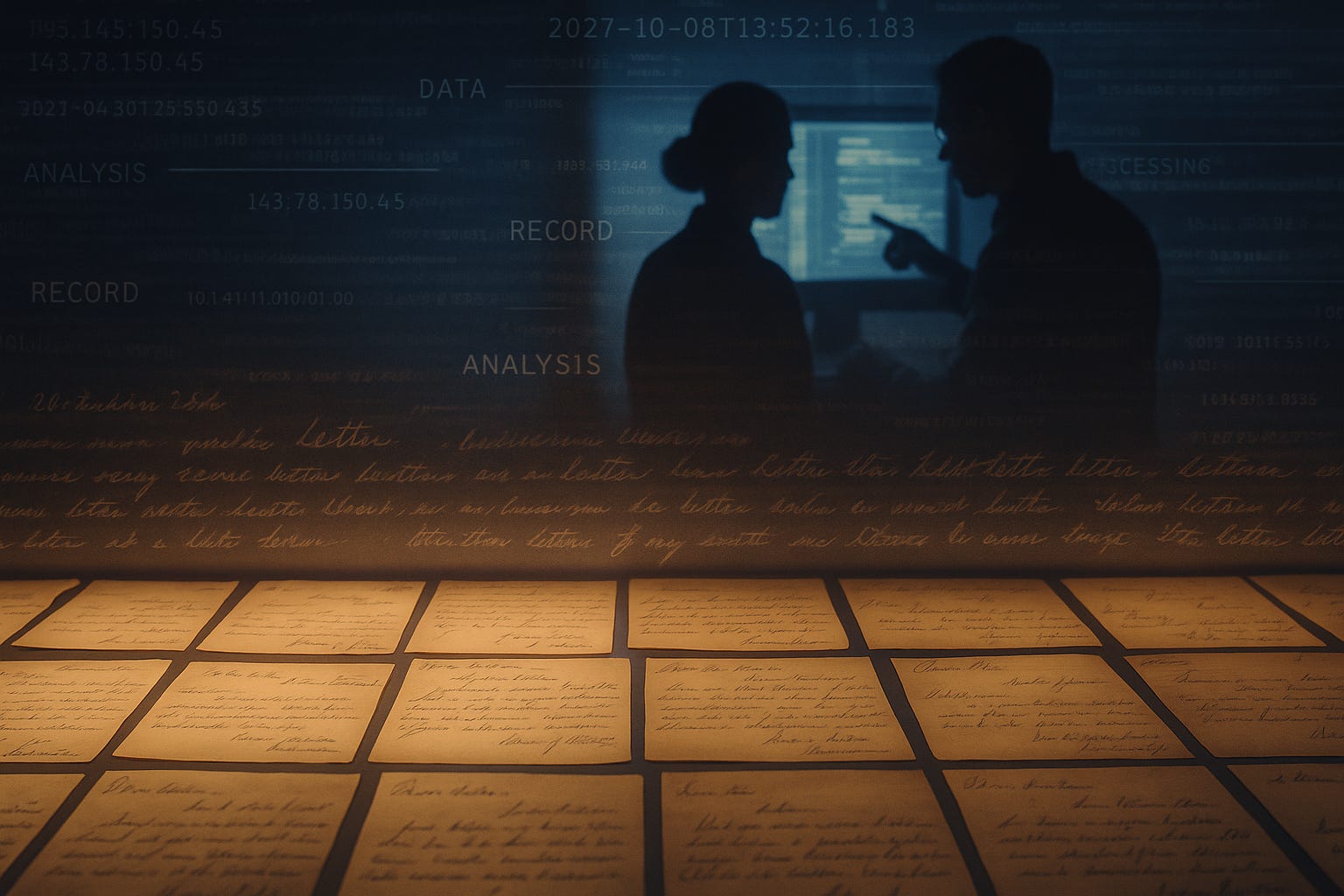
In the Journal of Contemporary Archival Studies earlier this year, Milan van Lange and Carlijn Keijzer of the NIOD Institute for War, Holocaust, and Genocide Studies published an illuminating study: Tracing Transformations: (Digitized) World War II Correspondence Through the Lens of the Records Continuum Model.
At first glance, their article seems narrowly focused—a case study of one institution’s digitization of wartime letters. Yet read closely, it opens into a broader meditation on what happens when records, people, and technology intersect over time. Their analysis doesn’t merely show how digitization works, but rather how records change—conceptually, materially, and socially—each time they are handled, described, or re-presented.
A Case of Continuous Re-creation
The NIOD’s Collection 247: Correspondence holds a remarkable archive of personal letters from the war years, encompassing soldiers, civilians, and those displaced or persecuted. Over decades, the collection has passed through many hands: letter-writers, family custodians, archivists, historians, and most recently, digital humanists training handwritten-text-recognition models.
Van Lange and Keijzer trace this journey across multiple layers of interpretation and intervention. The wartime letters are no longer fixed artifacts from a single moment of creation—they are cumulative outcomes of decades of curatorial and technical decisions. Every transcription, metadata field, or machine-learning model adds another layer of meaning, whether intended or not.
Their central insight is deceptively simple: digitization is not a final act of preservation, but another phase of record creation. Each transformation—scanning, encoding, training, validating, or publishing—introduces new relationships and new dependencies. The result is a multi-temporal object that reflects not only the moment it documents but every stage of its custodial life.
Egodocuments: The Personal Record as Evidence
The NIOD letters belong to a class of sources known as egodocuments—a term coined in the 1950s by Dutch historian Jacques Presser to describe those historical writings in which the researcher encounters an “I” as both author and subject. Egodocuments include letters, diaries, travel journals, and memoirs: records where the individual self is inseparable from the act of documentation.
They are not administrative artifacts produced under formal authority but personal expressions created in specific social and emotional circumstances. As such, they often follow unpredictable trajectories—saved by relatives, reorganized by later generations, and finally absorbed into institutional archives. In this sense, egodocuments exemplify the complex blend of personal, familial, and institutional agency that the authors seek to illuminate.
Van Lange and Keijzer treat them as living records that evolve through each stage of handling—from the writer’s first inked words to the machine-readable transcript on a public website.
From Method to Mindset
To navigate this complexity, the authors use the Records Continuum Model (RCM) as a way of mapping actions and actors over time. In their hands, the model functions less as a management tool than as a method of seeing. It reveals how creating, capturing, organizing, and sharing records often occur simultaneously and recursively, across generations of custodians.
What stands out here is not allegiance to one theoretical model over another, but the shift in perspective: a move from “life-cycle thinking,” with its clear beginnings and ends, toward a recognition that recordkeeping is continuous and socially embedded. Each interaction—archival, technical, or interpretive—creates new evidence and new context.
This perspective also invites reflection on archival accountability. Transparency about how records are altered, described, and disseminated becomes part of the ethical structure of recordkeeping itself. Provenance is no longer only about origin; it extends to the social and algorithmic systems that shape how information is found and understood.
Digitization as Co-Creation
One of the article’s most striking sections concerns the introduction of automated text recognition (ATR). Using the Transkribus platform, the NIOD team produced transcriptions that occasionally outperformed human readers—and occasionally fabricated entire lines of text.
Van Lange and Keijzer treat these algorithmic outputs not as errors to be erased but as additional traces in the record’s ongoing transformation. In this reading, the computer becomes another participant in the record’s biography—a non-human co-creator whose influence must be documented and interpreted.
The authors propose a practical response: embed data provenance, model versioning, and error metrics directly into archival metadata. This is not about distrusting technology, but about making its role visible. It’s an approach that aligns with emerging ideas of digital archival literacy—the understanding that every dataset carries the imprint of human and technical choices.
Egodocuments and Family Custodians
The case studies they present—a young Dutch man’s passport repurposed as a family memorial album, and a set of love letters later expanded by descendants into a digital compilation—illustrate how records can shift from bureaucratic forms to personal artifacts and back again.
These transformations remind us that the custodians of personal archives—families, donors, even citizen scientists—participate in recordkeeping as meaning-makers, not merely as sources. A record’s evidential value depends as much on these later reinterpretations as on the initial act of creation.
What This Means for Practice
The authors refrain from prescribing a single model of recordkeeping. Instead, they demonstrate that any model—continuum, lifecycle, or hybrid—must account for the social and technical realities of practice. Implementation becomes less about compliance and more about reflexivity.
A few themes emerge:
Digitization equals creation. Every digital surrogate is a new record with its own provenance.
Documentation of process is itself preservation. Contextual metadata—who, how, and why—is as critical as content.
Transparency builds trust. Recording algorithmic and human interventions supports accountable scholarship.
Interdisciplinarity is essential. Archivists, historians, and technologists share responsibility for how digital collections are shaped and interpreted.
Education matters. Digital archival literacy should be considered a foundational competency for anyone engaging with retro-digitized or born-digital sources.
Neutral Ground, Shared Space
What makes Tracing Transformations so valuable is its refusal to argue for one records model over another. Instead, it situates the discussion in practice. Whether one thinks in terms of life cycles, continuums, or other frameworks, the real challenge lies in acknowledging that records are never static—they are social, material, and now, computational entities.
By tracing how wartime letters became datasets, the authors offer a quiet but persuasive reminder: the work of recordkeeping is not about fixing the past, but about maintaining its intelligibility as it moves through time.
In that sense, the continuum is not only a theoretical diagram—it’s the lived experience of archives in motion.