
The Last Appraisal
Who decides whether a permanent record's original survives digitization?

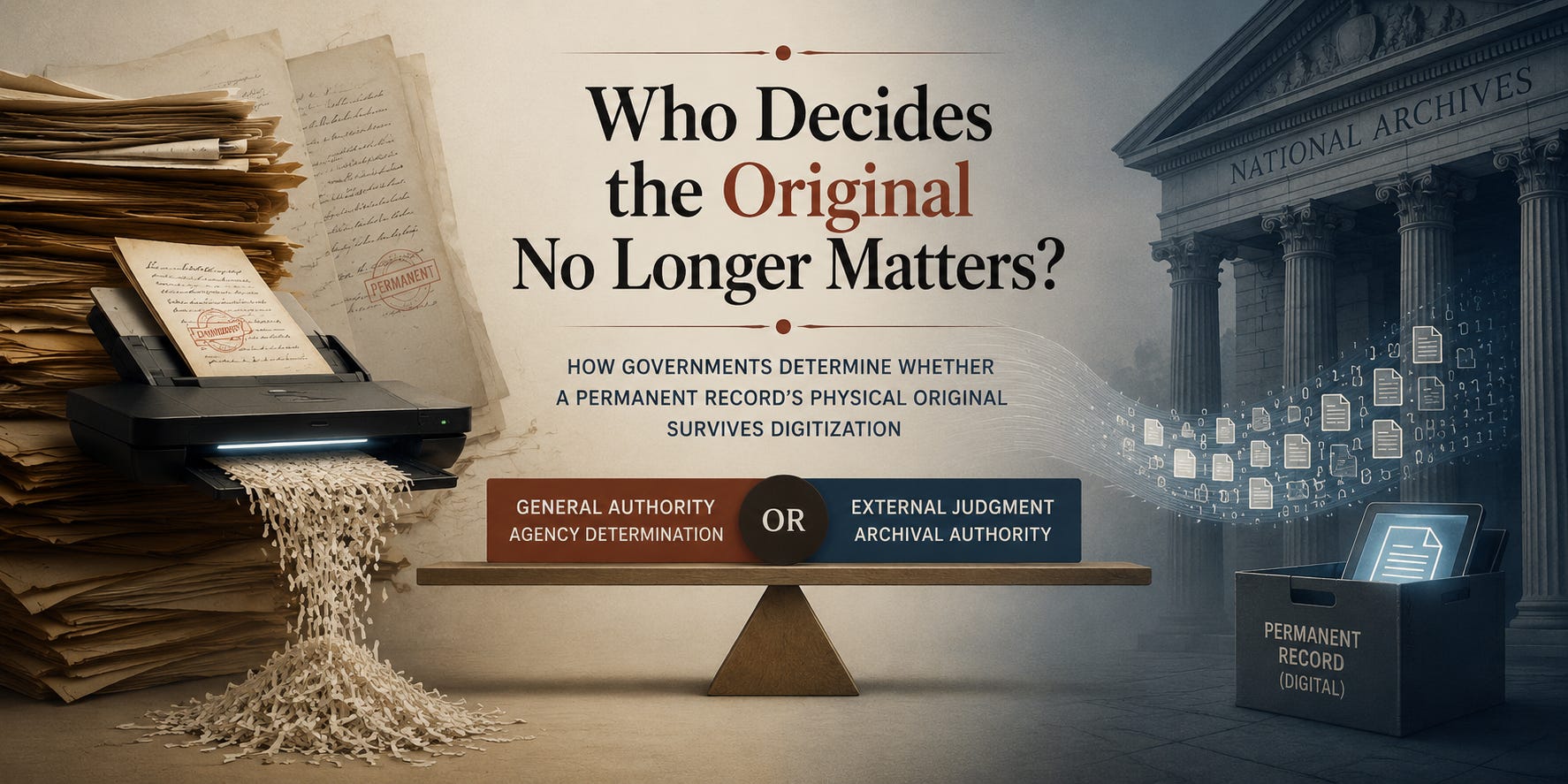
A permanent designation is supposed to mean survival. That is the point of the term. When an archivist marks a record permanent, the decision reflects a judgment, reached through appraisal, that the record’s content and evidential value warrant preservation by the national archives for as long as the institution endures. It does not necessarily mean that every physical manifestation of that record must survive indefinitely, but it is reasonable for most people, including many working records professionals, to assume that the physical original itself is what eventually reaches the archives.
Under current United States federal regulation, that assumption is often wrong. An agency may digitize a permanent paper record, validate the digitization against federal technical standards through a process conducted by staff separate from those who performed the digitization quality-control inspections, and dispose of the source document under an applicable disposition schedule, all before the record has ever physically reached the National Archives. What eventually arrives at the National Archives is not the original physical manifestation. It is the validated digitized record that federal regulation itself recognizes as the permanent record, produced and vouched for by the same agency whose paper original it replaces.
This is not a hypothetical edge case. It is the intended operation of 36 CFR Part 1236, Subpart E, together with General Records Schedule 4.5. Subpart E sets the standards an agency must meet to digitize permanent paper records, and specifies that once validated, the resulting digitized records are themselves the permanent federal records going forward. GRS 4.5 supplies the disposition authority for the paper source, subject to categorical exclusions covering records identified as having intrinsic value, records created or received before January 1, 1950, records in formats Subpart E does not yet cover, and noncompliant digitization. Separately, Part 1236 requires the agency to consider whether litigation holds, national security considerations, rights and interests, appeal rights, benefits, or other legal and business needs require continued retention of the source before using the schedule to dispose of it. Intrinsic value is a categorical exclusion within GRS 4.5 itself; the other reasons for retention are set out in a related but distinct provision that the agency must check separately.
The two authorizations, digitization validation and source destruction, are not sequenced to require National Archives custody first. Because permanent records are ordinarily transferred according to the timing already set in their existing disposition schedules, source destruction may occur well before archival transfer, in some cases years before.
Archival theory has a settled, if narrower than commonly assumed, answer to what should never be allowed to happen to such a record: its physical form should be preserved when that form carries value a copy cannot. This is the doctrine of intrinsic value, formally articulated by the National Archives and Records Service in 1982, developed during the period surrounding a 1979 push by the General Services Administration for large-scale microfilming of federal holdings. The doctrine holds that some records are valuable not only for what they say but also for what they are in themselves, and that a narrow, identifiable subset of records must be exempted from any general rule permitting destruction after copying.
The tension worth sitting with is that intrinsic value was built as a narrow exception, and the general rule it excepts from has grown considerably larger and more routine in the decades since. The GRS 4.5 mechanism lets an agency destroy a permanent record’s paper original under a standing NARA-approved authority, following its own validation of the digitization and its own determination that no exclusion or continuing retention requirement applies. The criteria for that determination, including what counts as intrinsic value, are NARA’s, set out in its appraisal policy rather than invented by the agency project by project. What the agency exercises is judgment within a framework it did not write, not an unrestricted preference.
The United States is not alone in having built a mechanism of this kind, and on at least one reading it is not even the most permissive example. Other jurisdictions have reached different answers to a question that lies beneath all of this: who determines when a permanent record’s physical form no longer needs to be preserved, and under what authority? Some systems place that determination with the same agency that created the record, operating under a general rule that it applies to itself. Others require a fresh, case-specific judgment from an external archival authority every time, regardless of how routine the digitization project has become. That line does not track the usual divide between common-law and civil-law systems, or between prescriptive American regulation and principle-based European practice. It cuts across both.
What follows is a comparative account of how the United States, Australia, the Netherlands, Spain, and France have each answered that question, with Italy and Germany considered separately as systems addressing a related but distinct problem, and a closing argument about what the doctrine of intrinsic value, built in 1982 to solve a specific American administrative crisis, is now being asked to bear.
The rest of this piece is for paying subscribers. It covers the regulatory architecture in each jurisdiction discussed above, the comparative claim that recordkeeping regimes divide by administrative model rather than legal tradition, and the theoretical lineage running from mid-century American appraisal writing through Schellenberg, Ham, and Cook to the specific argument, advanced by Lynn Westney, that a digital surrogate may not be able to carry forward what intrinsic value was invented to protect.
