
The Invisible Architecture
Quantum Computing’s Information Crisis


There is a scene that recurs across the history of large technical programs. Brilliant people are working. Money is moving. Agencies are meeting. But when an auditor arrives and asks a simple question: what are we trying to achieve, by when, and how will we know if we succeeded? The answer fragments. It exists in someone’s head, surfaced once in a meeting no one documented, or sits scattered across half a dozen planning documents that do not reference each other. The program is not failing. It is succeeding in an information vacuum. That distinction matters enormously, because vacuums are invisible until something collapses into them.
In records management terms, this is a failure to convert operational activity into institutional knowledge.
This is the situation a new GAO report finds at the heart of America’s National Quantum Initiative. GAO-26-107759, published in March 2026, audited the federal government’s quantum computing strategy against six standard characteristics that any coherent national strategy should exhibit. The findings are striking not for the technical failures they expose (the quantum science appears to be advancing) but for the information infrastructure failures they reveal beneath it.
In federal terms, these are not just coordination gaps. They are failures in creating and maintaining the records required to document government activity.
Two of the six characteristics are fully met. Four are only partially met. Performance measures: absent. Future budget projections: absent. Specific agency roles: unspecified. Integrated agency-level plans: incomplete. Meeting outcomes: undocumented. And the fundamental unit of the quantum workforce, what exactly constitutes a “quantum worker,” has no agreed-upon definition at all.
Records and information science (RIS)—the interdisciplinary field that integrates records management, archival science, and information science to design systems that capture, manage, and preserve information as reliable evidence over time, and which practitioners often experience operationally as records management and information governance—has spent a century developing tools for exactly these problems. The field exists because human organizations, left to their own devices, generate knowledge faster than they can capture, organize, and transmit it. What the GAO report diagnoses is not a quantum problem. It is a records, accountability, and information architecture failure wearing a quantum suit.
Four Deficits, Named Precisely
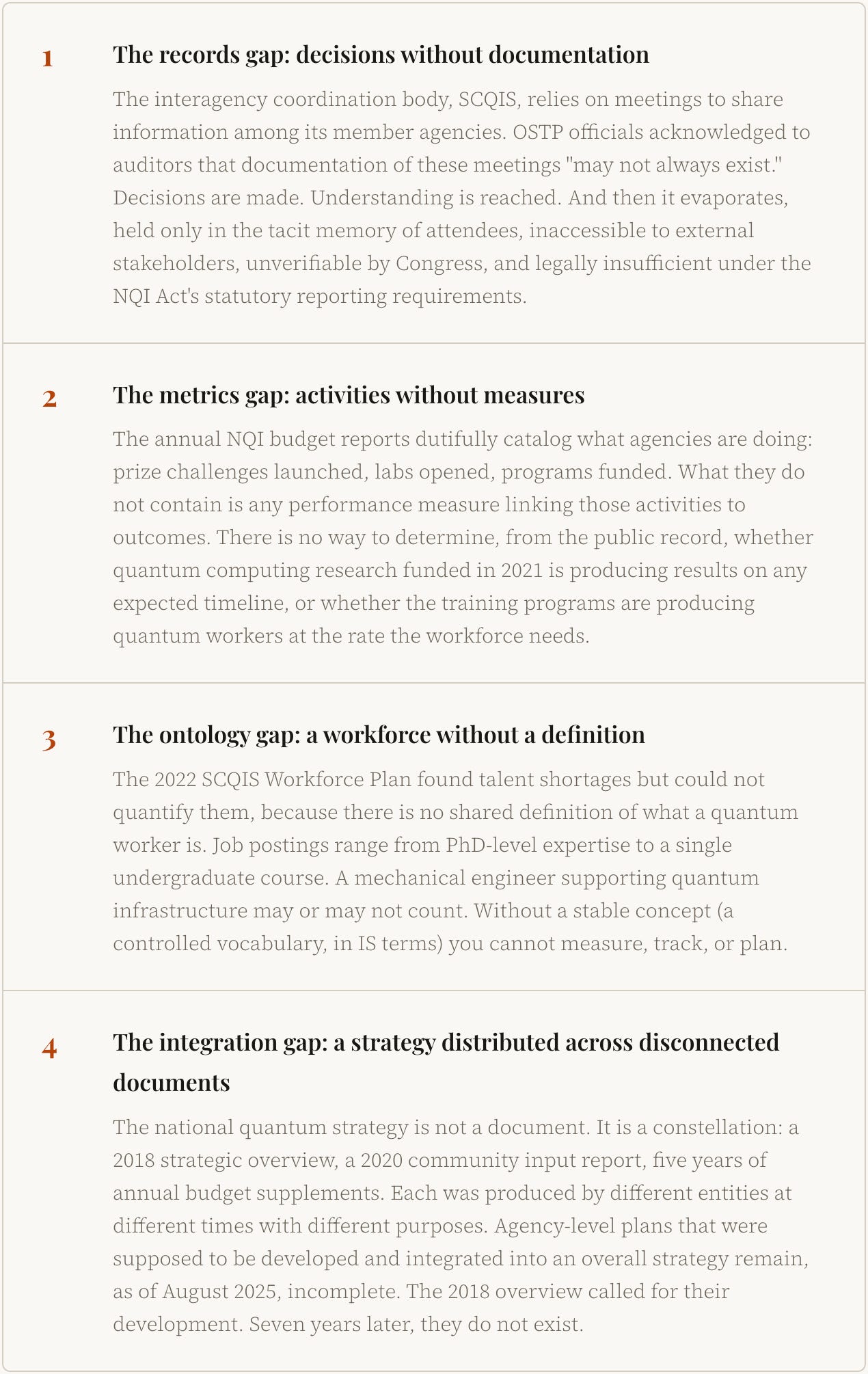
Before reaching for the remedies, it is worth naming the deficits with precision. The GAO report identifies four distinct information infrastructure failures, each with a specific character and a distinct body of literature.
What Records Science Actually Offers
Records and Information professionals are sometimes treated as the administrative cousins of the “real” disciplines, the people who manage the filing system while engineers do the important work. This is a profound misunderstanding, and the state of quantum computing illustrates why. The filing system, properly understood, is not separate from the work. It is the connective tissue that makes large-scale, multi-organization, long-horizon work coherent at all.
Consider what ISO 15489, the international standard for records management, actually demands of an organization. It requires that records be created as a byproduct of business processes, built into the workflow rather than added after the fact. It requires that records be authentic (they can be proven to be what they claim to be), reliable (their contents can be trusted to be complete and accurate), and, critically, usable—meaning they are organized and described in ways that allow retrieval and use over time.
The standard draws a hard line between communication (the exchange of information) and records (information captured with context, structure, and evidentiary accountability). Interagency coordination meetings produce communication. They do not automatically produce records. The distinction is not semantic. It determines whether a decision becomes institutional knowledge or remains personal memory.
Unrecorded decisions are not simply lost information. They are actions that cannot be evidenced, audited, or held accountable.
The Ontology Problem Is Upstream of Everything Else
The workforce measurement problem deserves special attention because it illustrates a principle that extends beyond records management. Before you can measure something, you must be able to define it. Before you can define it, you need a stable concept. And stable concepts, in information science, are the products of deliberate work: domain analysis, terminology development, and controlled vocabulary construction.
The GAO report surfaces this precisely. OSTP officials told auditors that uncertainty about what constitutes a “quantum job” makes workforce assessment impossible. Industry representatives described the difficulty of classifying workers whose quantum involvement is partial or indirect.
This is not a data problem. It is a concept and classification problem—and those sit upstream of everything else.
From an appraisal perspective, this means the program cannot even determine what constitutes a significant activity, let alone evaluate its long-term value.
You cannot measure what you cannot define. And you cannot define what you have not deliberately conceptualized.
The Distributed Document Architecture Problem
The national quantum strategy is not a document. It is a constellation: a 2018 strategic overview, a 2020 community input report, and five years of annual budget supplements. Each was produced by a different entity at a different time for a different purpose. Agency-level plans that were supposed to be developed and integrated into an overall strategy remain incomplete as of August 2025.
The strategy is, in practice, a collection of planning intentions rather than a unified planning document.
Performance Measurement as Information Design
The absence of performance measures in the NQI planning documents is often treated as a management accountability failure, and it is. But from a records and information management perspective, it is also an information design failure. Performance measures are, at their core, a specification of the information the organization needs to produce about itself to know whether it is succeeding.
The GAO report notes that the annual NQI budget reports describe what agencies are doing but do not identify performance measures to gauge results. This means the reports generate activity data but not outcome data. The information they produce cannot answer the question that matters: whether federal quantum computing investments are producing results at a rate that justifies the expenditure.
The Deeper Problem: Confusing Communication with Records
Beneath all four specific deficits lies a single conceptual error that is extraordinarily common in technically sophisticated organizations: the conflation of communication with records creation.
When smart people talk to each other and reach a shared understanding, it feels like the work is done. The understanding exists. The coordination has occurred.
What is needed is for the participants to externalize that understanding: capture it in a form that is independent of the people who reached it, accessible to those who were not present, and durable over time and across organizational change.
Tacit knowledge is valuable and irreplaceable in the moment. It is catastrophic as the primary vessel for a ten-year, multi-billion-dollar national technology strategy.
What Good Looks Like
The visible outputs—reports, dashboards, metrics—are downstream of invisible infrastructure: ontologies, taxonomies, metadata schemas, and classification systems.
When that infrastructure is missing, you get what the GAO report describes: information that is useful, but incomplete, inconsistent, and non-integrated.
Without defined records, there is no basis for disposition—only indefinite accumulation or premature loss.
The Audit That Should Have Been Unnecessary
GAO-26-107759 should not have needed to be written. The requirements it evaluates against were all mandated by the National Quantum Initiative Act. The law specified what information the program needed to produce about itself. The program did not produce it.
What is missing is not the knowledge to build this infrastructure.
It is the recognition that building it is as critical as the technology itself.
America is building quantum computers without building the records and information systems required to demonstrate, evaluate, and be accountable for what it is building.
That is the finding.
The tools to address it have been available for decades.
The question is whether anyone in a position to act will decide to use them.