
45² and Counting
What a Math Nerd Taught RIMPA Live 2025 About AI

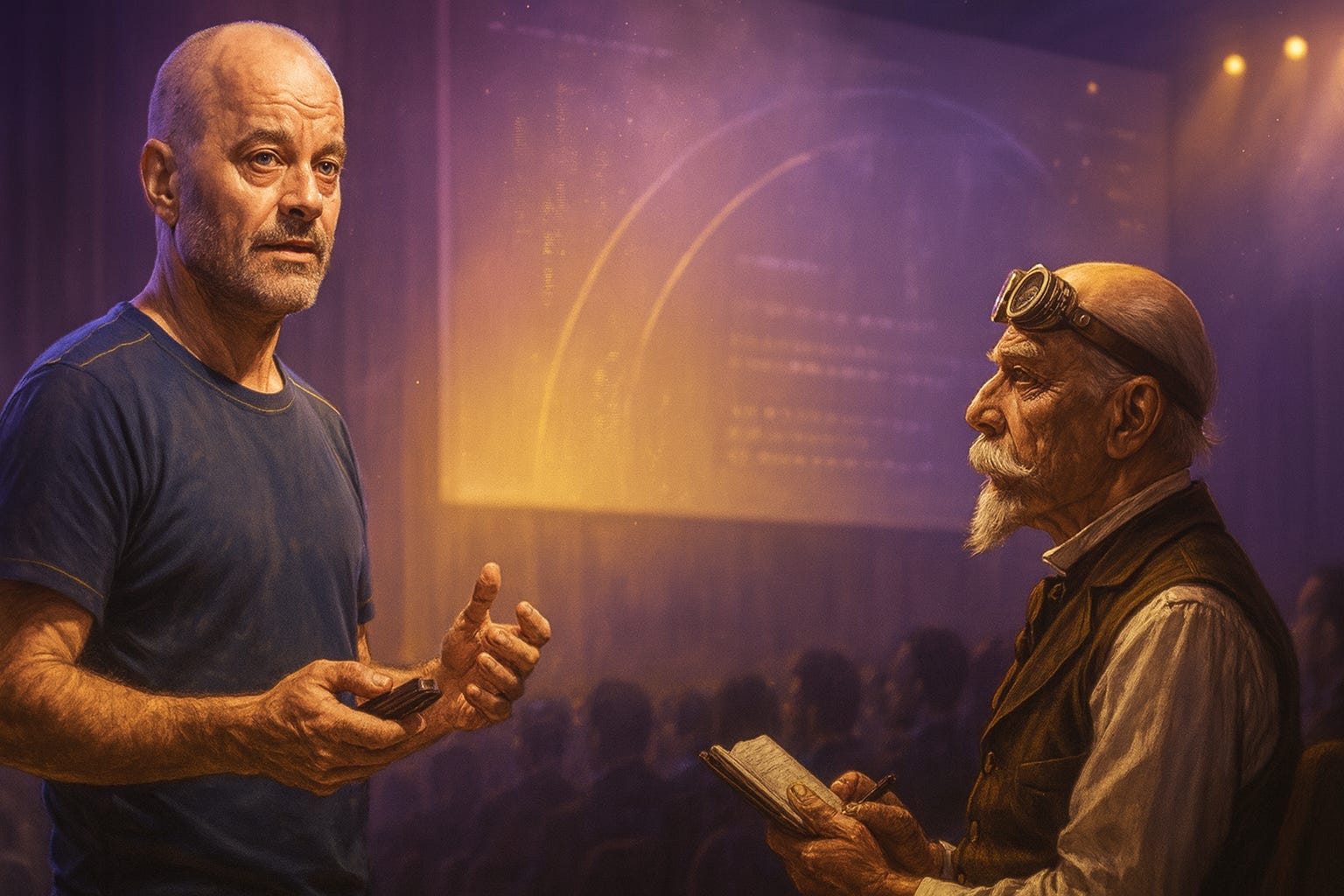
Dispatch from Melbourne
The room hums with that particular kind of early-morning conference buzz — half caffeine, half curiosity. Iron Mountain’s banners frame the stage, celebrating forty years of RIMPA, and the room feels like a bridge between two eras: the custodians of paper past and the stewards of digital futures.
I’ll admit, I walked in cold. I hadn’t heard Adam Spencer before — the name meant nothing to me beyond the printed program. Within minutes, though, he had the crowd — and me — completely. A mathematician by training, he once chased a PhD in pure maths at the University of Sydney before pivoting to radio, television, and comedy. What he brought to the keynote was that rare mix of intellectual precision and comic timing: a mind trained for proofs, now turned loose on the chaos of AI.
45 Squared = 2025
He began, fittingly, with a number trick. “Twenty-twenty-five equals forty-five squared,” he announced, delighted as if he’d discovered a cosmic secret. That little coincidence, he said, was reason enough to celebrate the year — the square of the future, so to speak. It set the tone: a talk built on curiosity and pattern recognition, both human and artificial.
From there, Spencer charted a dizzying arc from the squeal of a 1980s modem to the whisper of GPT-4. He showed an old BBC clip of someone sending an email for the first time — a process involving cables, sockets, and six minutes of static. “That,” he said, “was the cutting edge once.”
Now, of course, we all carry supercomputers in our pockets — the same devices we use to doomscroll the news between sessions.
The GPT Revolution
Spencer’s keynote wasn’t a technical lecture. It was a story about scale — how generative models shifted from parlor trick to planetary infrastructure almost overnight. He walked the crowd through his favorite “AI hallucination,” a comically over-engineered answer to the classic five-litre jug, two-litre jug puzzle, before flashing a slide that has already become legend in AI circles: GPT-4’s jump over GPT-3 on standardized tests. “This,” he said, “is the day everything changed.”
He described the movement toward Artificial General Intelligence — systems that could outperform most humans at most tasks by 2030 — and the hypothetical Superintelligence that could outpace all of us by 2040. His tone wasn’t alarmist, just pragmatic: this train is moving fast, and we’d better learn to drive before it drives us.
Hallucinations and Handshakes
The real magic of the session was how Spencer translated complex AI behavior into human experience. He showed how NotebookLM could turn a 400-page PDF into a nine-minute podcast. He played an entirely synthetic television ad — no actors, no cameras, just algorithms — that had aired during the NBA Finals. And he demonstrated the generational leaps in image and video generation, from the early, glitchy “Will Smith eating spaghetti” clip to today’s almost indistinguishable fakes.
Each demo landed somewhere between awe and unease. The audience laughed — then fell quiet.
Lessons for the Information Professions
Somewhere in between the jokes about Iron Maiden sponsorship and the mathematics of joy, Spencer dropped the line that resonated most for me:
“Information management professionals stand at the heart of this revolution. You manage the data that fuels AI, govern its outputs, and safeguard trust.”
He wasn’t talking about metadata in the abstract. He meant the real work — classification, retention, integrity — the unglamorous backbone of organizational memory. Tools like Iron Mountain Insight and Microsoft Syntex already classify and tag at machine speed, but the human judgment behind them still matters. “Hire a digital assistant who’s already two years into the job,” he quipped.
His caution was equally sharp. The energy demands of data centers now exceed entire Australian states. Bias seeps into every dataset. And overreliance can dull the intellect: one MIT study showed students using GPT exhibited less brain activity and weaker memory recall.
“We might be outsourcing the learning,” he warned, “before we’ve finished the lesson.”
Augment, Don’t Abdicate
Spencer’s takeaway for the week — and for the records world — was simple: use AI to amplify, not to replace. Build systems that make you better at what you’re already good at, not lazier at what you should know.
He spoke of the “age of apprenticeship” at risk — when new professionals learn through tedium and repetition, not shortcuts. Cut that stage out, he said, and you lose tomorrow’s experts.
Then, with a grin: “If you’re using ChatGPT to fill your gaps — be careful. It’s like sending someone else to the gym for you.”
The Math of Trust
By the end, the ballroom felt lighter, smarter, a little more human. Spencer’s brilliance lies in making AI feel like an extension of the same curiosity that once drove him to chase prime numbers across infinity. The challenge he left hanging in the air was not whether machines can think, but whether we’ll still choose to.
As I left the hall, someone nearby said what I’d been thinking: “That was the first keynote in years that made me want to open a spreadsheet.”
If that’s not evidence of a paradigm shift, I don’t know what is.